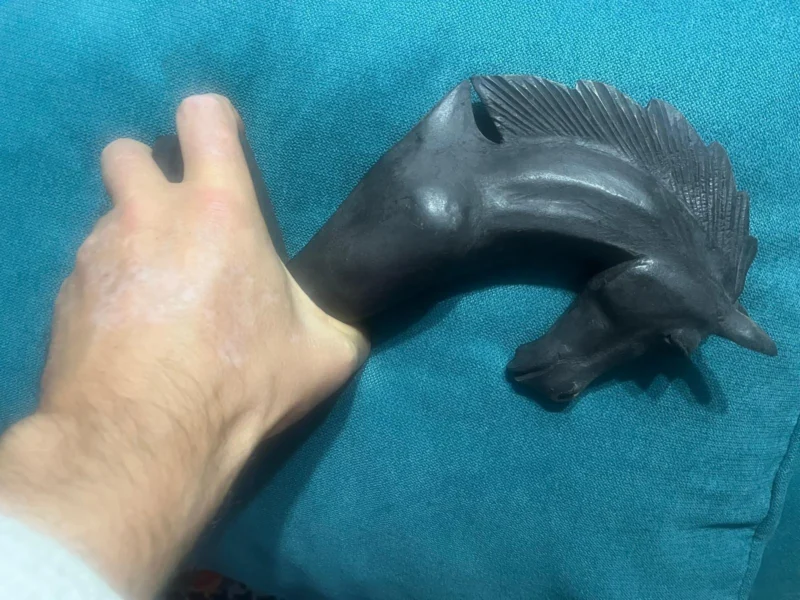
Sebastian's Journal
The Long Way Back to Myself — My Vitiligo Story, Part 3
Miracle creams, empty promises and the sun I was told to fear. Part 3: how I stopped fighting my skin and began looking for…
After my diagnosis, I searched for answers one spoonful at a time. Part 2: shame, music, my son, and becoming the person I once needed.
My Vitiligo Story — Part 2
New here? Start with Part 1: The First Time I Felt Alone.
As the days went by after my diagnosis, I became obsessed with finding out more about this strange condition. Why did I have it? Why was there no cure? And why did nobody seem to know much about it?
My attempts to find answers felt like those of a prisoner trying to escape by digging a tunnel with a tiny coffee spoon.
One spoonful at a time.
Information was almost nonexistent back then. And it didn’t take me long to realize that many doctors seemed just as uninformed as I was. Some even appeared uninterested in a condition they couldn’t cure.
The first treatment I heard about was PUVA therapy. I never tried it. I had only just discovered it, I didn’t have the money, and, perhaps more importantly, I was ashamed of my condition.
Funny how those things come together in the beginning.
Fear. Shame. Uncertainty.
And slowly, almost without noticing, you begin to lose confidence in yourself.
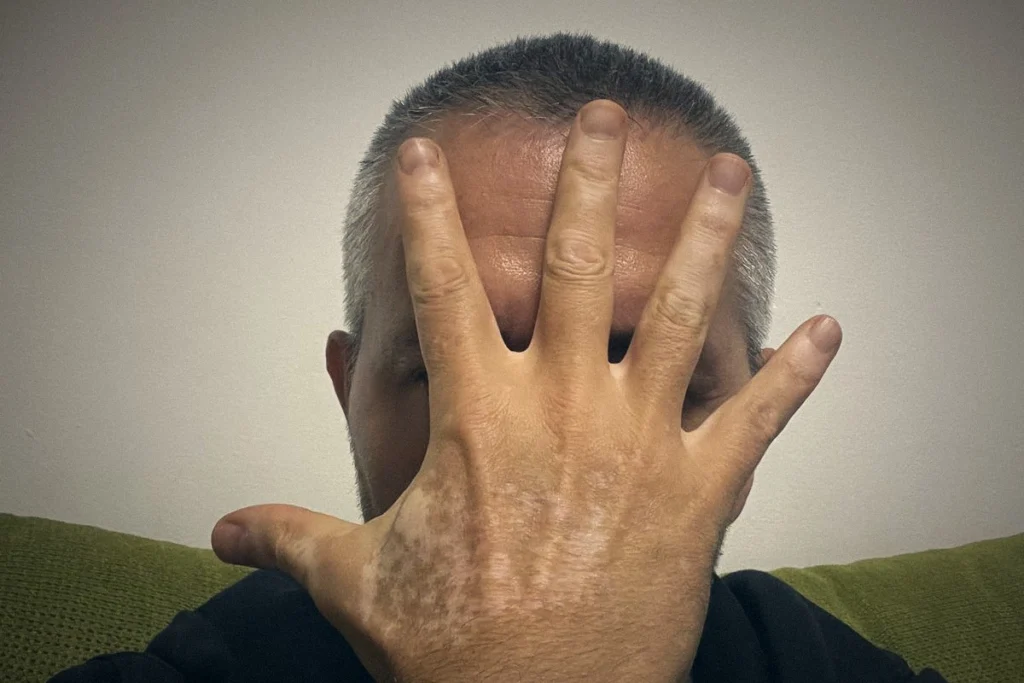
It was especially difficult because some of the white patches were on my face. People noticed them. People asked questions.
“What’s that on your forehead?”
“Just something from the sun,” I’d reply.
Short. Simple. End of conversation.
Maybe I was embarrassed to explain that I had a condition I believed was incurable.
Or maybe I was lying to myself, pretending it was something temporary. Something that would eventually disappear.
During my first year with vitiligo, I started escaping into alcohol, other substances, and an almost desperate hunger for women and short-lived relationships.
Looking back, I think I was running away from myself.
Somewhere in my mind, there was this ridiculous but terrifying thought:
What if, in a few years, I look like a Dalmatian? Will everyone start avoiding me? Will anyone still want me?
And there was another problem.
I was a musician.
A frontman in a band. Someone who stood on stage, in front of people, under the lights. I was quite visible in those days.
And back then, I still wanted to be a rock star.
I hadn’t yet understood that music was the important part. Not the way the person playing it looked on the outside.
But when you’re young, ambitious, and suddenly your appearance starts changing without your permission, it’s not that easy to be philosophical about it.
Especially when people who don’t understand vitiligo give you those strange looks.
You know the ones.
The quick glance. The second look. The silent question.
Sometimes nobody has to say anything to make you feel different.
Over the years, I’ve come to think that perhaps growing up with vitiligo from early childhood can be easier in certain ways. Not for everyone, of course. But when it’s been part of your life since you were three or four, you may have more time to grow into it, rather than suddenly having to adjust to a completely different reflection in the mirror.
I’ve met many people whose vitiligo started at that age.
And there’s something very personal about this for me.
My son has vitiligo too.
His first patches appeared when he was eleven. He’s fifteen now, and so far, the condition hasn’t spread.
But his experience has been very different from mine.
He has a father who lives with vitiligo. A father who feels comfortable in his own skin, who doesn’t see it as a tragedy, and who can explain what it is without fear or shame.
We’ve talked openly about the condition, what we know about it, and how we try to manage it.
He understands.
And today, he’s a positive, happy teenager.
Just as I am a positive, happy man now.
I sometimes wonder how different those first years might have been if I’d had someone like that beside me. Someone who could have looked me in the eyes and said:
“Your life isn’t over. You’re still you.”
But I didn’t have that person.
I had to become that person.
And it took years.
Years of confusion, desperate searching, bad decisions, and fighting with a reflection in the mirror that I didn’t recognize anymore.
I didn’t know it then, but I wasn’t really searching for a cure.
I was searching for a way to feel like myself again.
And that journey was only beginning.
End of Part 2.
See you next week.
— Sebastian
Vitiguru | Real Skin. Real Stories. Real Life.
Miracle creams, empty promises and the sun I was told to fear. Part 3: how I stopped fighting my skin and began looking for…
I was 26 when a dermatologist told me: “It's vitiligo. There is no treatment.” Part 1 of my story about the shock and loneliness…